With AI tools becoming more readily available to everyone, many programmers, makers, and researchers are beginning to run machine learning models and local LLMs on their own computers instead of using the cloud solely.
No matter if you’re trying out local AI chatbots, training ML models, or making applications with AI-enabled features, the type of GPU you choose will play a critical role in how well your local LLM or machine learning function runs.
In this article, we explore some examples of the best GPUs for AI workloads today. These examples cover creating ML models and running local LLMs.
Why GPUs are Important for AI Workloads
AI models require high-speed computations due to the size of the data sets and also the complexity of the neural networks.
GPUs are perfect for this task because they provide the following:
- Significant parallel processing power
- High memory bandwidth
- Specialized AI acceleration cores
- Higher training/inference speeds
Because of these advantages, GPUs are an essential part of any AI development project, deep learning research, or local LLM testing.
What GPU Specs Matter Most for AI?
When choosing a GPU to perform AI tasks, some specifications are more important than others.
1. VRAM Capacity:
Having more VRAM allows for the use of larger AI models, allowing them to run smoothly across multiple GPUs.
2. Tensor / AI Accelerators:
Recently manufactured GPUs come equipped with specialized cores that offer accelerated matrix computations leveraged heavily during the training of deep neural networks. These accelerators significantly improve both training speeds and inference speeds.
3. Memory Bandwidth:
When performing AI workloads, there is a need for quick access to large data sets which makes memory bandwidth an essential component of efficient processing.
A comprehensive list of specifications can be seen here to keep you on track when researching and purchasing your next GPU
Running Local LLMs: Hardware Considerations
More and more developers are running AI models locally over the last few years.
Some examples of local LLM tasks include:
- Running AI Chatbots
- Testing Language Models
- Building AI Applications
- Experimenting with Open-Source Models
A well-functioning AI setup locally will typically have:
- A GPU with good computational power
- 12 - 16 GB VRAM
- Fast NVMe storage
- Adequate system RAM
Best GPUs for AI, Machine Learning, and Local LLMs (Ranked)
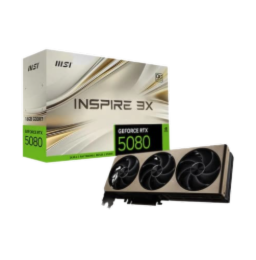
1. RTX 5080 - Best High-End GPU for AI Workstations
The NVIDIA GeForce RTX 5080 is the most powerful next-generation GPU on the market, designed specifically for the most demanding applications and workloads.
Reasons Why It Is Good For AI (Artificial Intelligence):
- New Advanced Tensor Core Architecture Allows For More Efficient AI (Artificial Intelligence) Acceleration
- Excellent Performance For Machine Learning Training and Inference
- High compute capability for complex AI models
- Ideal for Developers and/or Professional Workstations
Best Use Cases:
- Advanced AI Development
- Machine Learning Training
- Running Very Large Local AI (Artificial Intelligence) Models
https://digibuggy.com/product/Gigabyte-RTX-5080-WindForce-OC-SFF-16GB-GDDR7-Graphics-Card
2. RX 9070 XT - Powerful Alternative for AI and Compute
The AMD Radeon RX 9070 XT is a powerful graphics processing unit that provides significant compute power.
Highlights of the RX 9070 XT include the following:
- Excellent raw compute performance
- Affordable pricing vs. other high-end GPUs
- Increased support for AI workloads via the ROCm ecosystem
- Ideal for workloads requiring significant compute power
Is suited for:
- GPU compute workloads
- In developing AI applications using AMD technology
- For use in developing high-performance systems.
https://digibuggy.com/product/ASRock-RX-9070-XT-Steel-Legend-16GB-GDDR6-Graphics-Card
3. RTX 5070 Ti - Balanced GPU for AI Development
The NVIDIA GeForce RTX 5070 Ti is an excellent option when considering the price-performance ratio and overall value.
The reasons to use this graphics card for AI include:
- Tensor cores capable of great acceleration
- Able to handle medium-sized ML workload
- Efficient power usage
- Good price-performance ratio
Who should use the NVIDIA GeForce RTX 5070 Ti for AI includes:
- AI developers
- ML experimentation
- Testing local models of AI
https://digibuggy.com/product/MSI-RTX-5070-Ti-MLG-Edition-OC-16GB-GDDR7
4. RTX 5060 Ti - Entry-Level GPU for Learning AI
The NVIDIA GeForce RTX 5060 Ti is an excellent entry-level option for those beginning their AI journey.
Why it is useful for beginners:
- Supports all modern AI frameworks.
- Entry-level price point for GPU-based AI.
- Ideal for smaller ML projects.
- Great for student projects or hobbyists.
Ideal for:
- Beginners learning ML.
- Small AI projects.
- Entry-level workstations for AI.
https://digibuggy.com/product/Gigabyte-RTX-5060-Ti-Windforce-Max-OC-16GB-GDDR7-Graphics-Card
Final Verdict
Choose the GPU based on your AI workload, not just the newest model name. For beginners, a 16GB RTX GPU is enough to learn AI, run small models and use Stable Diffusion. For serious local LLMs, RTX 4090 and RTX 5090 are much better because 24GB–32GB VRAM gives more room. For professional AI workstations, RTX 6000 Ada, RTX PRO 6000, A100 or H100-class GPUs make sense when VRAM, stability and production workloads matter.
For most serious Indian buyers in 2026, the best practical choices are:
|
Buyer Type
|
Best GPU Direction
|
|
AI student / beginner
|
16GB RTX GPU
|
|
Stable Diffusion creator
|
RTX 4070 Ti Super / RTX 5080 class
|
|
Local LLM enthusiast
|
RTX 4090 / RTX 5090
|
|
Small startup AI workstation
|
RTX 5090 or RTX 6000 Ada
|
|
Professional studio / lab
|
RTX PRO 6000 / A100 / H100 class
|
If you want a balanced AI workstation instead of guessing parts manually, configure your build with Digibuggy here: https://digibuggy.com/product/configure
Frequently Asked Questions (FAQ’s)
Which GPU is best for AI in 2026?
RTX 5090 is the best consumer GPU for serious local AI in 2026 because it has 32GB VRAM and strong CUDA support. For professional work, RTX 6000 Ada, RTX PRO 6000, A100 and H100-class GPUs are better depending on workload and budget.
How much VRAM do I need for local LLMs?
For small 7B/8B models, 8GB–16GB VRAM can work with quantization. For 13B/14B models, 16GB–24GB is better. For 30B/32B models, 24GB–32GB is recommended. For 70B models, 48GB+ or multi-GPU setups are usually needed.
Is RTX 4090 still good for machine learning?
Yes, RTX 4090 is still very good for machine learning because it has 24GB VRAM, strong CUDA support and excellent AI performance. It is still worth buying if the price is significantly lower than RTX 5090.
Is RTX 5080 good for local LLMs?
RTX 5080 is good for small and medium local LLMs, AI learning and Stable Diffusion, but its 16GB VRAM limits larger LLM workflows. For serious local LLM work, RTX 4090, RTX 5090 or workstation GPUs are better.
Is NVIDIA better than AMD for AI?
Yes, NVIDIA is usually better for AI because CUDA has wider support across PyTorch, TensorFlow, TensorRT, llama.cpp, vLLM and many AI tools. AMD can work for some workloads, but compatibility needs more checking.
What GPU is best for Stable Diffusion?
For Stable Diffusion, a 12GB–16GB NVIDIA RTX GPU is enough for many users. For LoRA training, high-resolution generation and heavy creator workflows, 24GB–32GB GPUs like RTX 4090 or RTX 5090 are better.
Can I train AI models on a gaming GPU?
Yes, you can train and fine-tune small models on gaming GPUs, especially NVIDIA RTX cards. But serious training needs more VRAM, stronger cooling, more RAM and sometimes multi-GPU or datacenter hardware.
Should I buy a used GPU for AI?
Buy a used GPU only if you can verify warranty, bill, thermals, fan condition and previous usage. Used RTX 3090 or RTX 4090 cards can be attractive for VRAM, but reliability risk is higher than buying new.
Is cloud GPU better than building a local AI PC?
Cloud GPU is better for short-term experiments and very large training jobs. A local AI PC is better if you run models often, need privacy, want predictable cost and prefer offline access.
What is the best budget GPU for AI learning?
A 16GB RTX card is the best budget direction for AI learning because it gives enough VRAM for small models, Stable Diffusion basics and PyTorch practice. Avoid 8GB if you want longer usefulness.