In event production, performance is not a luxury.
It is a non-negotiable requirement.
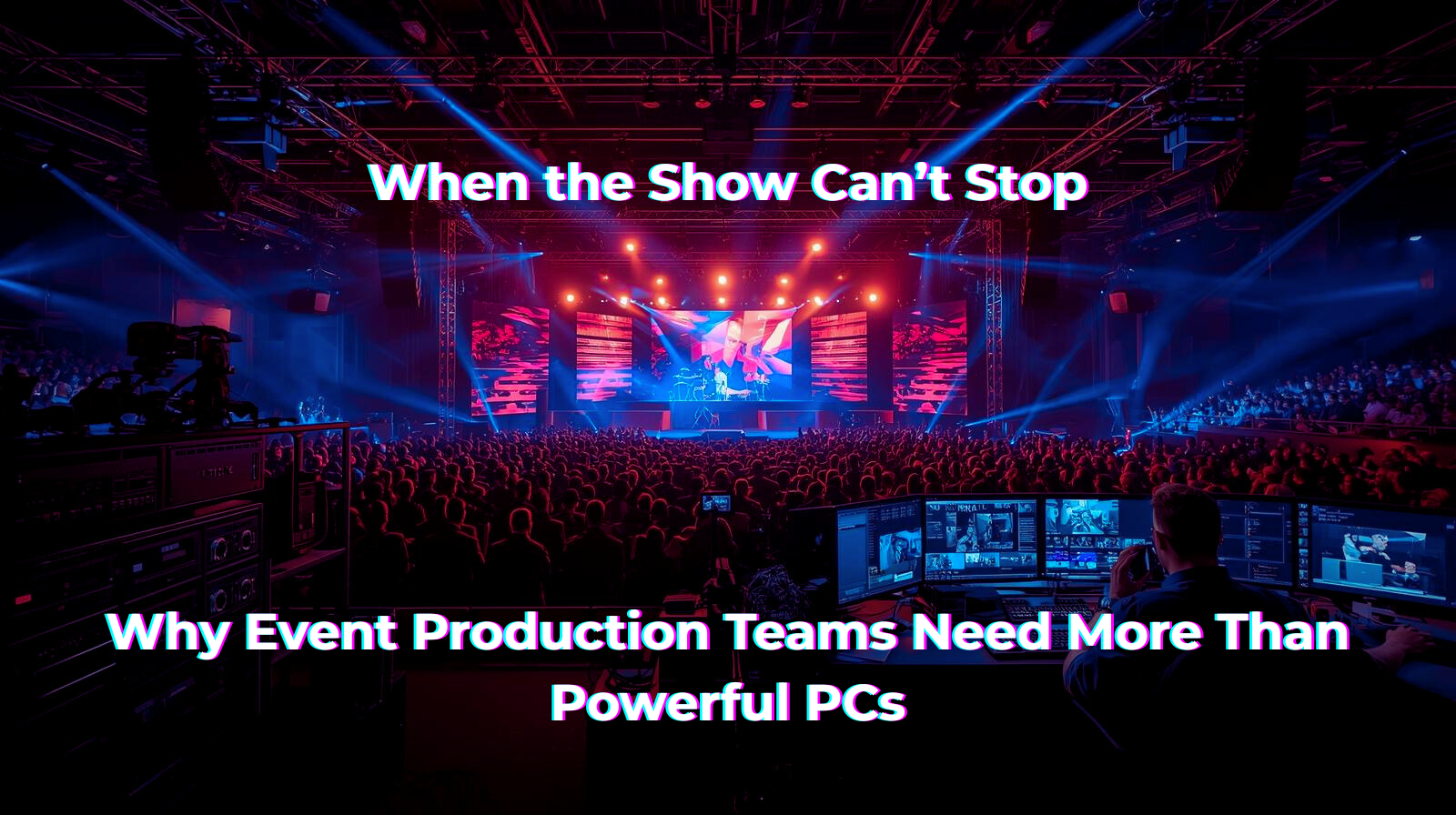
Live shows, concerts, corporate events, product launches, hybrid conferences, and large-scale experiences all operate under one rule: there are no second chances.
A dropped frame, a frozen feed, a delayed cue, or a system crash does not just disrupt workflow. It disrupts the event itself.
Yet many event production teams rely on systems that look powerful on paper but fail under real, time-critical pressure.
Why Event Production Workloads Are Uniquely Demanding
Event production systems are unlike typical creative workstations.
They are expected to handle:
- Live streaming with minimal latency
- Multi-camera ingest and switching
- Real-time video playback and editing
- Audio processing and synchronization
- Stage visuals, lighting control, and show cues
- Continuous operation for long hours without interruption
These tasks often run simultaneously, not sequentially.
Systems that perform well in studio environments can struggle badly on-site when everything runs at once.
The Common Mistake: Treating Event PCs Like Creative Workstations
Many event teams purchase systems designed for editing or rendering and expect them to perform the same way during live shows.
This is a costly assumption.
Live production environments demand:
- Absolute system stability
- Predictable performance under sustained load
- Low-latency data handling
- Thermal resilience in uncontrolled environments
- Hardware redundancy planning
Generic high-performance systems are rarely tuned for these conditions.
Why High-End Specs Still Fail During Live Events
Event production failures are rarely caused by insufficient hardware power.
They are caused by system behavior under pressure.
Common issues include:
- CPUs throttling due to thermal buildup
- GPUs prioritizing background tasks incorrectly
- Storage bottlenecks during simultaneous read-write operations
- Power instability under fluctuating loads
- Cooling systems not designed for continuous peak usage
In a live event, even a few seconds of instability can have visible consequences.
Reliability and Predictability Matter More Than Peak Performance
In event production, peak benchmark scores are irrelevant.
What matters is:
- Consistent frame delivery
- Stable clock speeds over long durations
- Zero unexpected slowdowns
- Reliable system recovery behavior
- Hardware that behaves the same way every time
A slightly less powerful but well-engineered system often outperforms a higher-spec machine that is not tuned for live environments.
Why Consultation Is Critical for Event Production Systems
Event production systems should never be built using a generic checklist.
A proper consultation considers:
- Type of events handled
- Software stack used during live shows
- Number of simultaneous feeds
- Latency tolerance
- On-site environmental conditions
- Backup and redundancy requirements
At Digibuggy, event-focused systems are designed using a consultation-first, engineering-led approach, ensuring that configurations are built around real production scenarios, not ideal lab conditions.
You can explore how Digibuggy’s consultation process works here
Designing for Failure Before It Happens
One of the most overlooked aspects of event system design is failure planning.
Professional event systems should account for:
- Graceful degradation instead of total failure
- Thermal headroom for unpredictable environments
- Power stability during load spikes
- Component behavior during extended uptime
- Fast troubleshooting and recovery
This mindset separates consumer-grade systems from enterprise-ready production machines.
The Value of Experience in Live Production Builds
Live production does not forgive inexperience.
System design decisions must be informed by what happens on the ground, not just in theory.
Digibuggy’s approach is shaped by 25+ years of PC building experience and over 45,000 systems built, including machines designed for performance-critical environments where downtime is not an option.
That experience helps avoid mistakes such as:
- Overloading systems with unnecessary background tasks
- Choosing components that behave unpredictably under live load
- Ignoring thermal and power constraints
- Underestimating sustained usage stress
Learn more about Digibuggy’s system design philosophy here
Support, Transparency, and Process Matter On Event Day
Event production teams do not just need hardware.
They need confidence.
Digibuggy supports this by offering:
- Online consultations for teams across India
- Pan-India shipping for enterprise setups
- An offline experience zone for system validation
- Transparent, guided build processes
- Real-world testing before deployment
You can also explore real builds and behind-the-scenes insights on Digibuggy’s Instagram
Making the Right Choice for Live Environments
Not every system failure is dramatic.
But every small glitch during a live event is visible.
Before finalizing your next production system, it helps to ask:
- Is this system designed for live workloads or studio use?
- Can it sustain peak performance for hours?
- How does it behave when something goes wrong?
- Are we planning for stability or just specifications?
The right system does not draw attention to itself.
It quietly does its job while the show goes on.
If you want clarity before investing in your next event production setup, a consultation-led discussion can help you make informed decisions that prioritize reliability over assumptions.
Frequently Asked Questions
1. Why do event production PCs fail during live shows?
Event production PCs often fail because they are not designed for sustained, real-time workloads. Thermal throttling, power instability, and storage bottlenecks commonly appear during live events when multiple tasks run simultaneously, even on high-end systems.
2. How are event production systems different from creative workstations?
Event production systems prioritize stability, low latency, and predictable performance over peak benchmarks. Unlike creative workstations, they must handle live feeds, real-time processing, and continuous operation without interruption.
3. Is it risky to use standard pre-built PCs for live events?
Yes. Standard pre-built PCs are typically optimized for general use and short testing cycles. Live event environments require systems designed specifically for sustained load, thermal resilience, and failure planning to avoid on-site disruptions.
4. Why is consultation important for building event production PCs?
Consultation ensures that systems are designed around real event workflows, software stacks, and environmental conditions. An expert-led consultation helps prevent performance failures, reduce downtime risk, and build systems that remain reliable under live production pressure.